

By C², Connie Colleen Wyatt, Occupational Therapist, PNW Home for Life PLLC and Holly Berard
If you’ve ever watched someone with Parkinson’s or dementia suddenly sit taller, smile wider, or move more freely the moment their favorite song plays, then you already know what I know:
Music is actual medicine.
Not metaphorical. Not poetic.
Neurological.
I’ve seen people who are frozen—literally unable to take a step—begin walking again once rhythm enters the room. I’ve watched slumped posture rise like sunrise. I’ve seen faces brighten, eyes widen, and souls wake back up.
So let’s talk about why.
🎵 Why Music Helps People With Parkinson’s Disease
People with Parkinson’s struggle because the basal ganglia—the part of the brain responsible for automatic, smooth movement—loses its ability to generate consistent internal timing.
But here’s where music becomes magic:
Auditory rhythm provides an “external timing signal.”
Music activates alternative brain pathways—especially the cerebellum and premotor cortex—allowing movement to bypass damaged systems.
As @theneuroguy_dpt explains:
“Auditory cues like a metronome or strong-beat music improve movement by giving the brain an external timing signal.”
That timing signal leads to:
- Longer, more confident steps
- Fewer freezing episodes
- Faster walking
- Better coordination
- Improved balance
- A sense of predictability and control
And when rhythm steps in, movement can feel automatic again.
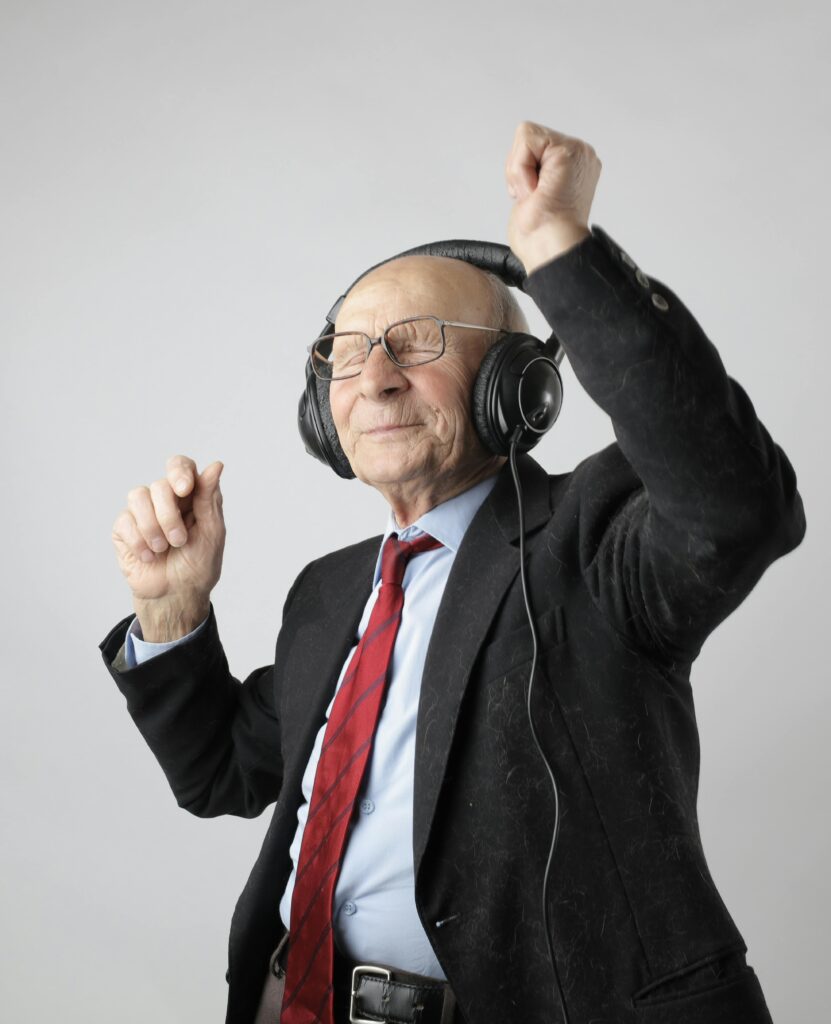
🎧 BPM Guidelines for PD Movement
(Yes—your playlist can be therapeutic!)
- 100–110 BPM → step taps + step-ups
- 120–130 BPM → intentional, rhythmic walking
- 140+ BPM → jogging or fast gait training
When I use these with my patients, the difference is immediate.
🎶 Why Music Helps People With Dementia
Dementia steals memory, language, planning, and problem-solving…
but it doesn’t steal music.
Here’s why:
Music is stored in multiple brain regions.
Even when language fades, musical memory often remains intact.
Music triggers the limbic system, sparking:
- Emotional memories
- Personal identity
- Moments of clarity
- Joy
- Connection
Music regulates the nervous system.
It can calm agitation, reduce anxiety, and increase engagement—especially for people who struggle to communicate their needs.
Music strengthens connection.
It gives care partners a way to “reach” their loved one again when words fail.
It’s one of the few tools that reliably bridges the cognitive distance dementia creates.
🌟 And Here’s the Part That Matters Most
My patients don’t just move better with music.
They become more themselves.
When Frank Sinatra comes on?
When Johnny Cash strums his first chord?
When ABBA hits the chorus?
When Elvis shakes the room?
I see:
- posture rise
- eyes sparkle
- shoulders relax
- faces soften
- sadness lift
- confidence return
Music is dignity. Music is identity. Music is memory. Music is joy.
And for my Parkinson’s and dementia patients, it is an essential therapeutic partner.
🧠 How OT Uses Music in Real Treatment
As an occupational therapist, music is not background noise—it’s a clinical tool.
Here’s how I integrate it:
- Rhythmic gait training for freezing episodes
- Dual-task training (movement + cognitive engagement)
- Emotional regulation during challenging tasks
- Motor planning with rhythm-based cues
- ADL training paired with preferred music
- Connection building between patients and care partners
- Posture improvement through music-driven engagement
And honestly?
Even if I didn’t have the science…
I would still use music because of what it does to the human spirit.
🎤 If You’re a Care Partner, Try This Today
Choose music your loved one used to enjoy between ages 15–30 — the “emotional peak music years.”
This range sparks the strongest neurological and emotional response.
Then try playing it during:
- walking
- morning routines
- cooking
- grooming
- stretching
- transitions
- emotional overwhelm
- restless moments
And watch what happens.
You’re likely to see the same transformation I see every day.
🔗 Want to Learn More About Movement, Aging, and OT?
Check out these related posts on my website:
- Why We Fall As We Age and How to Stop It
- Strength Training Isn’t Just for Buff Guys—It’s Longevity Insurance
- Bulletproof Your Aging: 6 Keys to Staying Strong, Safe, and Sharp
When words fade, rhythm remains.
By C²
connie@pnwhomeforlife.com
360-770-1752
Discover more from PNW Home For Life
Subscribe to get the latest posts sent to your email.